
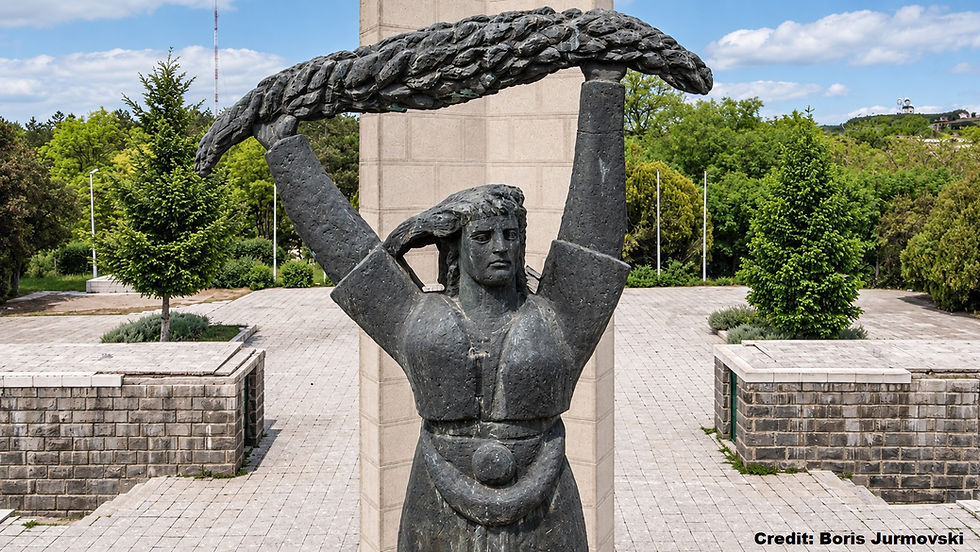

Kumanovo
Brief Details:
Name: The Memorial Ossuary of Kumanovo [Спомен костурница во Куманово]
Location: Kumanovo, North Macedonia
Year completed: 1957
Designer(s): sculptor Sreten Stojanović & architect Koča Zordumis
Coordinates: N42°08'42.9", E21°43'21.2"
Dimensions: 13m tall obelisk next to a 5m tall bronze statue
Materials used: Stone and bronze
Condition: Fair to good
(Куманово)
(koo-MAN-oh-voh)
History:
This section explores the WWII history of Kumanovo, as well as examining the construction and cultural heritage Memorial Ossuary built in 1957 commemorates the Partisan fighters and victims of fascism who fell during the war.
World War II
When Axis forces invaded the Kingdom of Yugoslavia on April 6th, 1941, Royal Yugoslav resistance forces collapsed extremely quickly. Most of Vardar Macedonia, including Kumanovo, was subsequently brought under the yoke of Axis-aligned Bulgarian administration. Kumanovo was strategically important as it stood along the major north–south roads and railway networks that connected Skopje with Vranje, Niš and Belgrade. Bulgarian authorities regarded the incorporation of Vardar Macedonia into their nation as part of a natural unification rather than occupation, while the Communist-led resistance characterized the regime as a fascist occupation. By September of 1941, the leadership of the Communist resistance in Macedonia was moving toward open armed struggle against this occupation, with the official "Day of Macedonian Uprising" starting on October 11th. For this effort, Kumanovo put forward the Kozjak and the Karadak Partisan Detachments. However, Bulgarian occupiers responded quickly to these actions of uprising. After only a few days after both of these detachments were formed, they were both vanquished by Bulgarian forces.

Photo 1: The formation of the 3rd Macedonian Assault Brigade at Žegljane in 1944

Photo 2: Delegates at the 1st Session of ASNOM at Prohor Pčinjski Monastery in August of 1944
After these defeats, the Partisan resistance in Kumanovo went into the underground, working towards efforts of sabotage, propaganda, weapons stockpiling and intelligence. By the summer of 1943, renewed efforts in Kumanovo were aimed at resurrecting the armed resistance against the Bulgarian occupiers, particularly under the leadership of Hristijan Todorovski-Karpoš, survivor of the original Kozjak Detachment. On February 26th, 1944 at Žegljane near Kumanovo, several smaller battalions were combined together to form the 3rd Macedonian Assault Brigade (Photo 1), one of the important early brigade-sized formations of the Macedonian People's Liberation Army. The This brigade operated extensively in the mountains and communications corridors around Kumanovo. Its activities increasingly targeted the infrastructure upon which the occupying forces depended.
On August 2nd, 1944, the First Session of ASNOM (the Anti-Fascist Assembly for the National Liberation of Macedonia) met at the monastery of Prohor Pčinjski, immediately north of the Kumanovo region (Photo 2). Partisan units operating around Kumanovo helped secure the surrounding territory. ASNOM proclaimed the Macedonian state within the emerging federal Yugoslavia and established Macedonian as its official language. Prospects for the Macedonian Partisans improved even further in September of 1944 as Soviet advacements through the Balkans resulted in the Bulgarian capitulation, which led to their occupational forces withdrawing from Kumanovo. However, just as the Bulgarians left the city, they were replaced by German Army forces who aimed to secure the now strategically important Kumanovo for the withdrawal of German troops from Greece northward back to Western Europe. As a result, Kumanovo Partisans rallied and targeted these Axis forces in their city starting in November of 1944 with a campaign called "Operation Stracin–Kumanovo".

Photo 3: The liberation of Kumanovo on November 11th, 1944
After weeks of onslaught by the Partisans, the German forces finally withdrew from Kumanovo on the 10th of November, with Partisans liberating the city on the following day, November 11th (Photo 3), led by the 17th and 18th Macedonian Brigades. During the course of the war, roughly 2,000 people from the Kumanovo region participated in the Partisan uprising against fascist occupation, with about 455 perishing during that struggle.
Spomenik Construction
By the early 1950s, local citizens and veterans' groups in Kumanovo were advocating for a central resting place and memorial space for the many fallen Partisans of the region who, at the time, were scattered in small burial locations across the local landscape. Such a memorialization effort was particularly salient as Kumanovo was one of the centers of armed resistance and uprising for Macedonia during WWII. This was also to be the first major large-scale monumental work created in the SR of Macedonia, so, efforts were put forward by SUBNOR and the People's Committee of Kumanovo to ensure it was an appropriate and sufficiently grand artistic gesture. The first phase of this project was to relocate, collect and inter the skeletal remains of the region's Partisan fighters into a collective ossuary crypt underneath the planned site of the monument. Various sources relate that the remains of somewhere between 300 and 443 fallen Partisan fighters were laid to rest here (accounts differ). This first-phase burial segment of the project was marked as completed on October 11th, 1952 during a ceremony which was presided over by Strahil Gigov, President of the Presidency of the People's Assembly of Macedonia. By that same year, the famous Bosnian-born Serbian sculptor Sreten Stojanović (along with Macedonian architect Koča Zordumis) were both secured by the monument project's main committee to helm the major second-phase expansion of the memorial ossuary. At this point in time, Stojanović was already a much-celebrated memorial sculpturalist, particularly for his 1951 Monument to Freedom at Iriški Venac in Fruška Gora National Park and his 1952 Gradina Hill monument at Bosansko Grahovo.

Photo 4: An early model of the Kumanovo female sculpture by Stojanović [source]
In the years just before working on this Kumanovo project, Stojanović had just completed an expressive sculptural bust of Vladimir Lenin, a work that later went on to appear on a series of Yugoslavia stamps celebrating the 100th anniversary of his birth. Work on the Kumanovo expansion project began around 1955. A photo of the preparatory work by Stojanović for his central female figure for this monument can be seen in Photo 4. Construction on this endeavor took roughly two years to complete. The official unveiling ceremony for the complex was held on October 11th, 1957, a date that marked exactly 16 years since the start of the Macedonian Partisan uprising. However, some sources also recount that the unveiling year was 1958, so some discrepancy exists. As of yet, I have found no photos or authoritative documentation revealing the details of this 1957/1958 unveiling ceremony.

Photo 5: The garden path leading to the Kumanovo Memorial Ossuary
The site was given the name "Memorial Ossuary of Kumanovo", an ossuary being a place where the skeletal remains of the deceased are reinterred long after their original burial. While I cannot find any evidence that Yugoslav President Tito attended this original unveiling ceremony, he did however make an official visit to this memorial site and preside over a ceremony here on November 7th, 1972. In fact, very little academic investigation or scholarship has been done examining the details of this monument as a whole and even less on Stojanović's creation of its various sculptural elements. I have found no photos of this monument under construction or any thorough accounts of the efforts or work that went into its creation.
This monument consists of multiple artistic pieces and architectural works. Approached from the south via a flat open garden space (Photo 5), a path leads to a grand stone staircase that takes the viewer up towards the two central elements: an unadorned tri-radial 13m stone obelisk (created by architect Koča Zordumis) rises behind a 5m tall bronze female figure (holding up high above her head a large sheaf of what some sources say is wheat and other say is laurel) who stands atop a 4m tall rectangular pedestal, all set upon an 18m wide semi-circular platform with rough stone walls. Two sets of stairs are recessed behind either side of this platform, next to which are two 13m long straight stone walls extending outwards that have flat bronze relief sculptures (2m x 3m) installed upon them on both sides. At the top of the stairs, a large stone paved plaza (37m x 18m), intended for ceremonies and commemorative events, opens up behind the obelisk. On the reverse plaza-facing side of the two straight walls, there is an installation of polished stone panels engraved with the names of the interred local fallen Partisan fighters.
It is important to mention that some elements of this site may have actually been installed AFTER the memorial ossuary's 1957 official opening date. For instance, newspaper sources from 1958 indicate that the bronze relief panels had not yet even been installed by this date, a year after the monument's alleged opening. It is also notable to point out that this is the last monument that Sreten Stojanović would create and contribute to during his life, as he passed away in 1960, just a few years after its unveiling.
Yugoslav-era to Present-Day
This was a cherished and beloved location for the city of Kumanovo during the Yugoslav-era, with the monument being prominently featured on promotional materials for tourists, postcards, pamphlets, and other publications of the time period. This monument was among the most important and extensive early works of Partisan memorialization in Yugoslavia (particularly for Macedonia). As was previously mentioned, even Yugoslav President Josip Broz Tito visited this site to preside over a remembrance ceremony in 1972 (Photo 6a). In fact, Tito was a common visitor to Kumanovo, visiting and paying tribuite to the city no less than six times during his life. The site's vast open memorial plaza (with its scenic views and contemplative atmosphere) was the most expansive commemorative space in Kumanovo and served as the most important venue in the city for ceremonial events related to honoring fallen Partisans and WWII victims (Photo 6b). Not long after its creation, the central female sculpture of this monument was integrated into the city flag and the city seal of Kumanovo, both of which the community continues to employ up to the present day. The fact that Kumanovo holds on tightly to its Partisan heritage, while many other cities across the former Yugoslavia were quick to shed such heritage in the post-1990s era, is largely the result of Kumanovo perpetually seeing itself as one of the great Partisan cities of Macedonia in respect to uprising and resistance.

Photo 6a: Tito, with Jovanka, in 1972 at the Kumanovo Ossuary
Considering its modest size, the greater Kumanovo region produced 8 Yugoslav National Heroes, second only to Prilep in Macedonia. This, among all these other reasons, largely explains why the city's main square continues to be named after Josip Broz Tito, why a monument to him could be built as recently as 2006, and why the Ossuary Memorial female sculpture continues to be the central element on the city's flag and seal up to the present day.

Photo 6b: A vintage postcard showing the ceremonial plaza of the Kumanovo Memorial Ossuary
The Memorial Ossuary at Kumanovo continues to be used as a place of memorialization for local Partisan fighters who fell during WWII up to the present day and has done so uninterrupted since its creation. However, it has received little maintenance and restoration since 1991. As such, it has fallen into a degraded condition, with many of its elements being damaged, defaced or derelict. This is the situation despite its designation as a protected cultural asset within the Law on the Protection of Cultural Heritage of Macedonia. However, as of 2024, pledges have been made by local authorities to repair and restore the monument.
Plaques, Engravings and Graffiti:
The primary elements at this monument site that bear any sort of engravings or inscriptions are a series of dark polished stone panels within the upper central plaza of the Memorial Ossuary. On the east wall of this broad plaza stands a series of stone panels that bear inscriptions of the names of six of the local National Heroes of Yugoslavia who were from the region of Kumanovo, in addition to other Partisans. The six National Heroes marked here are Hristijan Todorovski-Karpoš, Pero Georgievski–Čičo, Bajram Šabani, Kiro Nacev–Fetak, Boro Menkov and Boro Petruševski–Papućar. Meanwhile, on the west wall of the plaza is another series of stone panels that bear the names of further local Partisan fighters who fell during combat and operations during WWII (Photo 7). The east side contains nine panels while the west side contains eight. From looking at historic photos of the complex, it appears as though these panels are not the originals that were installed here, as vintage images indicate that the original panels were of a lighter colored stone.

Photo 7: A photo of the west wall name inscriptions on stone panels
Interestingly, these are the only significant inscriptions or engravings present at this memorial ossuary. There are no poetic stanzas, speech quotes or other notable words inscribed on any other elements of this monument nor do there appear to ever have been. This is interesting as that monuments of this size in Yugoslavia often contianed numerous other engraved elements, yet, further examples are not present here.
Symbolism:
The central symbolic form of the Kumanovo Memorial Ossuary is the 5m tall bronze sculpture of a female form. This sculpture is credited to the sculptor Sreten Stojanović (Photo 8). The woman is depicted as a modest mother-figure in folk dress and covered hair. She is rendered in a romantic emotive fashion, akin to the style of Socialist Realism, a style that Stojanović often employed, feeling that it strongly communicated noble heroicism and monumentality. Above her head, the figure lifts high into the sky a large sheaf of grain (which is the interpretation of most sources), an object symbolic of the region's agricultural bounty and wealth, as grain has been Kumanovo's most important commodity crop. However, it must be said that other sources, such as Grujić, assert that the object is instead a laurel branch, symbolizing an incarnation of the spirit of the Partisan victims. In addition, the figure's raised arms stance and vertical movement is also an unmistakable gesture of victory and triumph, similar to that of Stojanović's female statue at Iriški Venac.

Photo 8: A close up view of the female sculpture at Kumanovo
.jpg)
Photo 9: The Liberty Statue in Budapest, Hungary
Keep in mind that despite the fact that this is an ossuary, Stojanović does NOT use a symbol of death or mournfulness but instead a symbol of liberation, life and fertility, all of which speak volumes to the intention of the artist in memorializing this resting place of fallen fighters. This can be seen to represent the sacrifice the Partisans were fighting for. Attention must also be given to the similarity of Stojanović's Kumanovo woman to that of the central female sculpture of the Liberty Monument in Budapest, Hungary (Photo 9), which was created in 1947 as a triumphal work by sculptor Zsigmond Kisfaludi Strobl in response to the city's liberation from Nazi occupation. However, while the Kumanovo woman holds a sheaf of grain above her head, the Budapest woman holds a palm frond, symbolizing liberation and peace. In light of the stylistic and thematic similarities, it is unknown if Stojanović was influenced by Strobl's work (which was very famous upon its unveiling), yet, it must be admitted that the depiction of a women holding wreaths, fronds and sheaves above their head is a not uncommon rendering in historical sculpture.

Photo 10: A photo of the right-most relief panel at the Kumanovo Ossuary

Photo 11: A photo of the left-most relief panel at the Kumanovo Ossuary
Sculptural Reliefs
On both sides of the straight stone walls radiating from the front of the Kumanovo Ossuary are a bronze sculptural relief panel that were both created by sculptor Sreten Stojanović. When facing the front of the monument complex, Photo 10 shows the relief panel on the right, while Photo 11 shows the relief panel on the left. Both panels measure roughly 2m x 3m in size. Sources indicate that these two panels have their creative origin as early as the mid-1940s and are connected to a cycle that Stojanović was creating at that time called "Second Battle Line/Drugi bojni red". In both scenes, the figures can be observed wearing traditional dress and attire of the Kumanovo region, particularly the men wearing the fabric sashes around their mid-sections (known as "pojas"), while the women wear head scarves and long dresses (known as a "košula").
The relief on the right, Photo 10, depicts a group of Partisan fighters bidding farewell to their loved ones in a large gathering, showing tender moments of parting with mothers, daughters, sisters and wives. It bears the title "Sloboda/Freedom". Much pathos is communicated with this work, particularly with the female figure at the center of the frame kneeling down in sorrow for her son/husband going off to war. No doubt this scene is meant to represent not only the sacrifice of the Partisan fighters but also the sorrow of the loved ones who are being left behind. In the background of the scene, tall spires of grain can be seen growing, again symbolizing the agrarian culture and abundance of the region.
The relief on the left, Photo 11, depicts those same Partisans in the midst of battle against the fascist occupiers. It bears the title "Borba/Fighting". Some Partisans have already fallen, some have just been struck, while others continue to hold the line. One reaches back holding up his falling comrade. In the background, a column of Partisans hold up their rifles in resistance and uprising. The center falling Partisan is bare-chested, a motif meant to symbolize defiant bravery against the most overwhelming of odds.
The last element of the Kumanovo Ossuary site that is worthy of examination is the tri-radial obelisk at the center of the monument created by its architect Koča Zordumis. Representing the highest point and most visible element of this memorial's composition, the obelisk serves as a vertical transfer of energy from the mortal remains buried beneath high into the heavens, representing liberation and renewed life. Meanwhile, the tri-radial nature of the obelisk, which allows it to be viewed the same as you circle around it, lends to this active processional "revolving" engagement with the object that could itself symbolize "revolution". Furthermore, each tri-radial wing of the obelisk expands outwards, perhaps representing the expansions and permeation across the landscape of the revolution and the power of those who perished on its behalf.
Status and Condition:
In the years since the dismantling of Yugoslavia, the upkeep and maintenance of the Kumanovo Ossuary has declined sharply. The site is often found defaced with graffiti, while broken stone pavers and small spaces of invading vegetation are common. While the central female sculpture appears to be in a fair state of repair, the two bronze relief panels are in a very poor condition, with some parts broken off and extremely corroded. Meanwhile, for many years, one of the polished stone panels that bore the inscribed names of local Partisan fighters was missing from one of the memorial walls; however, as of 2024, it was replaced. A 2022 article by the outlet "САКАМ ДА КАЖАМ" relates many of the deteriorating elements of this complex. Their article relates that during a 2016 ceremony, the President of the Kumanovo Council, Maksim Dimitrievski, remarked in response to all of the damage at this monument: "This is a shame not only for us, but primarily for those of us who have received the mandate to lead the country." Meanwhile, there are no signs or markers along the surrounding roads advertising or drawing attention to this monument for visitors, nor are there any interpretive signs or educational boards relating the history or significance of the site. Though, it is important to mention that Kumanovo's official tourism website features the Kumanovo Ossuary as an important local tourist attraction and site of cultural interest.
However, despite the deteriorating condition of this memorial site, annual commemorative events are still held here every year, particularly on October 11th (Photo 12), a date which marks the start of the Partisan uprising in Macedonia during WWII in 1941. These ceremonies are sponsored by the local government and often attended by high-level politicians from across the country. The Kumanovo Ossuary is protected on the local level and on the national level by the Ministry of Culture as a place of immovable cultural heritage. In 2023, extensive work began towards restoring, rehabilitating and cleaning the ossuary site, with much work already completed by 2026 by the Ministry of Culture and the Conservation Center of Skopje. However, much work is still needed and consistent and continual maintenance is required to prevent the monument from falling into a poor condition yet again.

Photo 12: A 2016 ceremony at the Kumanovo Ossuary
Additional Sites in the Kumanovo Region:
In this section, we will explore other significant Yugoslav-era cultural sites and monuments that are situated in and around the Kumanovo region. These will include the Monument to the Revolution, the Monument to the Karadač Detachment, and the sites related to the 1st ASNOM Session at Prohor Pčinjski Monastery.
Monument to the Revolution:
In the center of Kumanovo within a plaza which is known as "Marshal Tito Square" is a memorial object called "Monument to the Revolution". Planning for this memorial began in the mid-1950s, with the commission for its creation going to the renowned Croatian design team of sculptor Kosta Angeli Radovani and architect Marijan Haberle. Finally unveiled on October 11th, 1962, this complex consists of two primary elements: the central female stone sculpture and three adjacent stone relief walls. Firstly, the female sculpture is a 5.5m tall highly abstract stylized figure carved from black basalt, which itself sits upon a 2.5m tall square pedestal (Photo 13). Known as "Makedonka" or "The Women of Macedonia", she is the embodiment of the nation, wearing long traditional garb and a modest head scarf, with her hands held behind her back. In a 1981 paper by Vojo Kuševski, she is described as having "tightly clenched fists behind her back, defying the enslaver and occupier, expressing her strength, defiance, militancy and courage."

Photo 13: A vintage postcard view of the Monument to the Revolution in Kumanovo
For 1962, Makedonska stands as a very unique sculptural memorial for the time period, particularly as abstract monumentality was only just becoming accepted within Yugoslavia. It starkly veers away from the austere Socialist Realism of Sreten Stojanović and instead embraces imaginative forms of modernist sculpture. In place of the traditional battle flags, raised fists, pointed rifles or charging soldiers, we instead see monumentality and defiance being achieved through a calm dignity, restrained gestures and an unwavering solid vertical mass.

Photo 14: One of the memorial walls at the Revolution Monument
Lastly, there are a set of three stone wall relief sculptures that are located in a grass tree-scaped park area just west of the central figurative sculpture. These walls stand roughly 3m tall and are carved from white Istrian limestone (Photo 14). Each wall depicts a scene from early to mid-20th century history of Macedonia: the Ilinden Uprising (1903), the Macedonian People's Uprising of WWII (1941-1945) and Socialist Reconstruction & Daily Life (1945 onwards). On one of these stone walls is a stanza from the poem "My People Before Disintegration/Мојот народ пред распаќа" by the famous Macedonian poet Ante Popovski. The stanza reads, when translated into English, as "This path leads from your nothingness to you." Sadly, over the years, the white Istrian limestone has weathered poorly, with many parts of the relief walls staining a deep black color, making Radovani's carvings almost impossible to interpret in certain places.
As a central public sculptural monument that sits right in the center of the city, the Monument to the Revolution is routinely visited by Kumanovo citizens and tourists, with it serving as one of the city's primary urban landmarks. As social media and Google indicate, people continue photograph themselves in front of it even up to the present day. However, the complex is often found defaced with graffiti, even despite municipal efforts to keep in cleaned. The exact coordinates for this monument are N42°08'07.9", E21°43'12.0".
Monument to the Karadač Detachment:
On the southern edge of Kumanovo is an area known as Menkova Koliba. Within this area is a monument that is dedicated to the fallen fighters of the 1st Kumanovo Partisan Unit (also known as the "Karadač Detachment"). It was at this location within a small wooden hut that the Partisan unit formed on October 12th, 1941 and was the first Partisan resistance group to form in the Kumanovo region. However, just two days after forming, the unit was attacked with gunfire by the Bulgarian occupation police when their secret hideout was discovered at Belanovce. Half the unit was captured and summarily sentenced to death, while the other half were killed in the gunfire exchange (including Magdalena Antova, Macedonia's first female soldier). The first version of a memorial object for this unit was created here in 1948, consisting of a simple concrete pyramid with a bronze relief of a Partisan fighter and a star serving as its only adornments. However, some decades later, presumably in the 1970s, this was replaced with a new monument.

Photo 15: A recent photo of the monument dedicated to the 1st Kumanovo Partisan Detachment
This new monument at Menkova Koliba was designed in the shape of a small stylized concrete hut (roughly 3m tall) meant possibly to symbolize the unit's formation within such an inconspicuous, modest structure (Photo 15). Adjacent to the monument is an additional element that consists of a low concrete table with several pylon seats positioned around it, perhaps symbolizing the gathering of Partisans to plan their uprising. However, I have not yet been able to establish the work's creator or even the year it was built. It stands today largely overgrown with weeds and covered in graffiti. All of the monument's inscriptions and engraved panels have been either stolen or destroyed. The exact coordinates for this monument are N42°06'40.5", E21°43'27.3".
1st ASNOM Session at Prohor Pčinjski:
Roughly 30km northeast of Kumanovo is the Prohor Pčinjski Monastery, just over the border into what is present-day Serbia in the Kozjačija mountain region. It was here within this monastery that the 1st Session of ASNOM (Anti-Fascist Assembly for the National Liberation of Macedonia) was held. This secret wartime event, brought together amidst Axis occupation, was organized by the Macedonian Partisans and served as a constitutive state-building assembly that laid the legal and political foundations for the subsequent Macedonian communist republic within Yugoslavia, as well as granting civil rights to the people of this new republic. Convened on August 2, 1944 (a date that symbolically marked 41 years since the famous Ilinden Uprising of 1903 against the Ottomans), the 1st ASNOM is considered one of the most vital milestones in the nation’s history. This monastery was chosen to host this session because of its location within a safe liberated zone at this point during WWII.

Photo 16: A vintage image of the ASNOM Memorial Hall at Prohor Pčinjski

Photo 17: A modern photo of the ASNOM Museum at Pelince, MK
In the years after the end of WWII, the room at Prohor Pčinjski Monastery where the 1st Session of ASNOM had taken place was preserved and turned into a memorial room for tourists to visit (Photo 16), being staged and arranged exactly as it was on that day in 1944. This was a hugely popular attraction and pilgrimage site (being given almost sacred status), with mass celebrations being held here every August 2nd during the Yugoslav-era. However, in 1998, during the process of Yugoslavia's disintegration, the monastery's historic ASNOM Memorial Room was dismantled and all of its exhibits removed under the direction of Serbian authorities and the Serbian Orthodox Church. As such, a new ASNOM Museum was constructed just south of the monastery in the Macedonian town of Pelince (Photo 17), about 25km northeast of Kumanovo. This new museum was opened in 2004 and was the work of famous Macedonian architect Georgi Konstantinovski. The interior of the museum contains a full reproduction of the 1st ASNOM Session Hall exhibit as it existed at Prohor Pčinjski, while the exterior of the museum features a massive mosaic mural on its front facade created by Skopje artist Rubens Korubin. The coordinates for the Prohor Pčinjski Monastery are N42°19'47.0", E21°53'44.9", while the coordinates for the new ASNOM Museum are N42°16'41.6", E21°50'57.8".
And Additional Sites around Kumanovo:
-
Hristijan Todorovski-Karpoš Museum: Near the center of Kumanovo just off of the main boulevard "3rd Macedonian Shock Brigade" is the home site of the famous Kumanovo Partisan Hristijan Todorovski-Karpoš. He became the commander of the Kumanovo "Jordan Nikolov Orce" Battalion in 1943 but was killed the following year leading a raid on the Bulgarian police station in Biljaca, near Preševo. Karpoš was declared a Yugoslav National Hero in 1945. On July 4th, 1979, his birthplace was set up as a museum dedicated to his life, with a bronze bust depicting him sitting in front of the museum on a stone pedestal. The building continues to operate as a museum to Karpoš up to the present day. Its coordinates are N42°08'02.3", E21°42'37.8".
-
The Zebrnjak Monument: East of Kumanovo about 5km is a 1st Balkan War memorial site known as "Zebrnjak". Built in 1937 and created by the architect Momir Korunović, the monument was created to commemorate the site of the 1912 "Battle of Kumanovo", where the Royal Serbian Army battled and came out victorious against the forces of the Ottoman Empire. The enormous 50m tall basalt block monument consisted of a towering church-like spire crafted in the Romantic style with a heavy fortress-like base (Photo 18). Inside the structure was an ossuary, a chapel, a memorial chamber, and frescoes by the artist Živorad Nastasijević. As WWII approached and the city of Kumanovo was taken over by the Axis powers, the Bulgarian occupational forces destroyed the tower with explosives in May of 1942. While the tower was completely toppled, the large base of the monument continues to remain as a ruins. Its coordinates are N42°08'57.1", E21°47'07.0".

Photo 18: A 1937 view of the Zebrnjak monument
-
"Josip Broz Tito" Cultural Center: In the center of the city of Kumanovo, right within Marshal Tito Square, is a complex that was originally known as the "Josip Broz Tito" Cultural Center, named after the president of Yugoslavia. Opened in 1981 and designed by Macedonian architect Blagoj Kolev, this facility served as the city's primary and largest cultural exhibition space for performances, concerts, shows and other events, having seating space for nearly 700 people. It is designed in a high-modernist style rendered in white concrete, with its facade characterized by expressive shapes along its rooflines, orange glazed glass facades and a cubist geometrical arrangement. In 1999, the "Tito" name of the institution was dropped and it was renamed after the Kumanovo-born composer Trajko Prokopiev, a name which it retains up until the present day. The exact coordinates for this complex are N42°08'05.4", E21°43'12.5".
Directions:
The Memorial Ossuary at Kumanovo can be easily reached by taking Done Božinov Street from the city center. If you are coming from the A1 Motorway, you can take the exit for A2, then the first exit for P-1204, then the very next exit for Kumanovo, which will take you onto Done Božinov Street. From either direction, an ample parking area is easily available on the west side of the road. The exact coordinates for this parking area are N42°08'39.6", E21°43'23.2". From here, exit your vehicle and you will easily find a paved walking path opening up through a black gate that will take you up to the top of the hill to the monument site.

Click to open in Google Maps in new window
Selected Sources and More Information:
-Glasni Idei article: "„Приказни за храброст, испишани на камен: Спомениците од НОБ во Куманово“"
-Macedonia Wiki article: "Спомен-костурница (Куманово)"
-Museum of Public Art article: "Уметнички Дела Куманово"
-Vera Grujić book: "Sreten Stojanović 1898-1960 : miris zavičaja"
-MARH article: "Спомен Костурница – Куманово"
-Zaum Archive clipping: "Žive legende ustaničkog grada" [PDF]
-
Comments:
Please feel free to leave a message if you have any comments, if you have any questions, if you have corrections or if you have any additional information or insight you feel might be appropriate or pertinent to this spomenik's profile page.